Spring
5 Centimeters per SecondSpring is the season through which the story connects Takaki Tohno’s childhood with his adult life: cherry blossoms fall in both, but what they mean changes with time. A childhood remark by Akari Shinohara becomes a lasting image, returning years later in Tokyo as Takaki watches petals descend beside a railroad crossing. Spring’s brightness does not erase separation; it makes the distance between past and present newly visible.
Childhood Blossoms and a Difference in Seeing
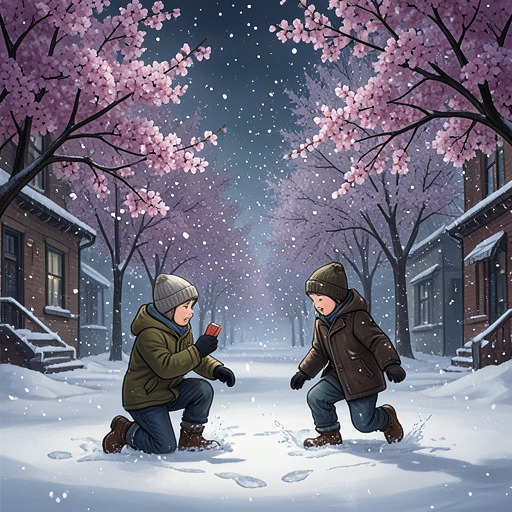
Seventeen years after Akari compared drifting cherry blossoms to snow, Takaki recalls the spring when they had just begun sixth grade. They were walking home from school with their backpacks, passing a small forest where the cherry trees were in full bloom. Petals silently covered the asphalt until it looked pure white. The air was warm, the sky pale blue, and although a major highway and the Odakyu Line were nearby, their noise scarcely reached the children. Birds were the only sound, and no other people were in sight.
The scene is remembered as almost perfectly composed: light, quiet, and a path shared by two children. Yet Takaki’s recollection complicates that serenity. He sees the children as if in snapshots or video footage, from outside the frame and usually from behind. In those remembered images, Akari runs ahead. The boy feels a faint loneliness, a small disturbance within the picture of spring that remains painful to the adult remembering it.
Akari’s words, “Look, it’s almost like snow,” give the falling blossoms a meaning Takaki cannot share at the time. He thinks she must mean that the clouds of petals resemble snow, but to him cherry blossoms are simply cherry blossoms, while snow belongs to winter. The difference is modest, not an argument: the children experience the same scene but do not see it in the same way. The adult’s attention to Akari’s comparison, seventeen years later, shows how an ordinary remark can outlast the moment in which it was spoken.
April in Tokyo
The later spring passage begins in April, with cherry blossoms tinting the streets of Tokyo. Takaki wakes close to noon after working until dawn and draws back the curtain on sunlight, hazy skyscrapers, and windows catching the light. Cherry trees are visible between mixed-use buildings. His recognition that Tokyo has many cherry trees links the city around him to the flowering landscape of his remembered childhood, while placing the same seasonal image in a denser, adult setting.
Spring also arrives alongside a change in Takaki’s working life. Three months have passed since he quit his company job. After a period without programming, he has recently begun taking small independent jobs through connections from his former company, doing both design and programming. He is uncertain whether freelance work can last, but finds himself absorbed by the work and pleased by the feel of his fingers on the keyboard. The season does not resolve that uncertainty; it accompanies the tentative beginning of something new.
Since leaving the company, Takaki has again noticed the city’s changing smells: morning, evening, and night each have their own character, mixed from people, the city, and nature. He walks through narrow residential streets, buys coffee from a vending machine, sits in a park, watches schoolchildren and traffic from a pedestrian bridge, and sees Shinjuku’s skyscrapers beyond the buildings. These details make spring more than a scenic backdrop. The season coincides with his renewed awareness of ordinary surroundings and the passage of the day.
The Railroad Crossing and the Returning Image
At a railroad crossing, a large cherry tree stands over asphalt whitened by fallen blossoms. Watching petals drift down, Takaki thinks, “That’s five centimeters per second.” The thought gives the falling flowers a measured pace, turning a visual detail into a recognition that connects this present-day scene to the story’s recurring image of slow descent. The crossing alarm sounds in the spring air, and its echo is colored by nostalgia.
A woman approaches from the other side. The clicking of her white mules joins the rhythm of the alarm, and the two pass each other in the center of the crossing. The scene establishes a moment of passing, not a reunion: it does not identify the woman or state that either person recognizes the other. Its ending therefore keeps the encounter open while grounding it in concrete sounds and movement. Spring brings the old image back, but does not undo the separation embedded in it.
Seasonal Meaning
Across these scenes, spring repeats a pattern of visual likeness and emotional difference. The sixth-grade children walk beneath blossoms that Akari sees as snow; the adult Takaki encounters petals again, now with the phrase about their falling speed in mind. The landscape returns, but the observer has changed: what the boy dismissed as simply cherry blossoms has become inseparable from memory.
The season holds together renewal and loss without making them equivalent. Takaki’s revived interest in programming suggests a fresh beginning, while the alarm’s nostalgia and the remembered loneliness keep the past present. Cherry blossoms mark a recurring time of year, but their significance depends on who is looking and what has endured. Spring thus becomes a measure not of distance traveled toward resolution, but of how an earlier moment can reappear in the present, altered by everything that separates them.